Argan Oil: Morocco's Liquid Gold — Complete Guide (2026)
The ultimate guide to Moroccan argan oil — from traditional Berber extraction methods to buying authentic cosmetic and culinary argan oil.
It Takes 30 Kilos of Argan Nuts to Make One Liter of Oil. Let That Sink In.
I want to tell you about the hardest-working tree in Morocco. It grows in a region so harsh that almost nothing else survives — the semi-arid soil between the Atlas Mountains and the Atlantic coast, southwest of Marrakech. It can live for 200 years. It provides food for goats (yes, you've seen the photos of goats in trees — more on that later). It prevents desertification. And its nuts produce one of the most valuable oils on Earth.
Meet the Argan tree (Argania spinosa). And its precious oil, affectionately known as Morocco's liquid gold.
The argan tree exists nowhere else on Earth except a 800,000-hectare UNESCO Biosphere Reserve in southwestern Morocco. Every drop of argan oil in the world — every high-end skincare bottle, every Michelin-starred kitchen drizzle, every wellness influencer's morning routine — comes from this specific patch of Moroccan earth. That's pretty extraordinary when you think about it.
Here's everything you need to know about argan oil, from the traditional extraction process to how to avoid buying counterfeit products.
The Traditional Extraction: Women's Work
Here's the thing about argan oil production that most people don't know: it's traditionally done entirely by hand by Berber women. For centuries, this knowledge has been passed from mother to daughter in the Amazigh communities of the Souss Valley and Essaouira region.
The process is labor-intensive in a way that will make you feel guilty about complaining about any task, ever:
Step 1: Harvesting
Argan fruits are harvested between June and August. The fruit looks like a small, wrinkled olive — yellow-green outside with a hard nut inside. Workers either knock the fruits from the trees with long sticks or collect them from the ground.
Step 2: Drying
The fruits are dried in the sun, which causes the outer pulp to split open, revealing the hard-shelled nut inside.
Step 3: Cracking the Nuts
This is where it gets wild. The hard argan nut must be cracked open by hand — one by one — to extract the 1-3 almond-shaped seeds (kernels) inside. There is no machine that can do this efficiently. The nuts are too hard and irregularly shaped. So women sit for hours, cracking each nut between two stones.
It takes approximately 30 kilograms of argan nuts (and about 10 hours of manual cracking) to produce just 1 liter of argan oil. Let that ratio settle in.
Fair warning: If you visit an argan cooperative, they'll likely let you try cracking the nuts yourself. You will fail spectacularly. The women will laugh kindly. Your thumbnail will hurt for three days. It's a humbling experience.
Step 4: Grinding
The extracted kernels are ground into a paste using a traditional stone rotary quern (rahra). For cosmetic argan oil, the raw kernels are cold-pressed. For culinary argan oil, the kernels are first roasted over a fire, giving the oil its distinctive nutty flavor.
Step 5: Extraction
The paste is hand-kneaded with warm water (for culinary oil) or cold-pressed (for cosmetic oil) until the oil separates out. What remains is a thick paste (amlou) that's used as a delicious spread mixed with honey and almonds.
Culinary vs. Cosmetic: Two Completely Different Products
This is the single most important thing to understand before buying argan oil. They are NOT interchangeable.
Culinary Argan Oil
- Made from roasted kernels — this gives it a warm, nutty, toasted flavor
- Deep amber to brown color with a rich aroma
- Used for drizzling on salads, couscous, tagines, and bread
- Should not be used for high-heat cooking — it's a finishing oil, like extra virgin olive oil
- Flavor profile: Nutty, earthy, slightly smoky with hints of popcorn and toasted almonds
- Shelf life: 6-12 months (roasted kernels oxidize faster)
Cosmetic Argan Oil
- Made from raw, unroasted kernels — lighter, more neutral
- Light golden color with minimal scent
- Used for skin, hair, and nails — it's rich in Vitamin E, essential fatty acids, and antioxidants
- Absorbs quickly and doesn't leave a greasy residue
- Shelf life: 12-24 months
Pro tip: Never put culinary argan oil on your face. The roasting process changes the oil's composition, and it can clog pores and cause breakouts. And never eat cosmetic argan oil — it tastes like nothing and wastes the product. They're two different things.
Amlou: The Best Thing You've Never Heard Of
While you're learning about argan oil, let me introduce you to its delicious cousin: Amlou. This thick, honey-brown spread is made from argan oil, crushed almonds, and honey. It tastes like the love child of peanut butter and heaven.
Berber families eat amlou on bread for breakfast, as a snack, and sometimes as an energy boost during Ramadan. You can buy it at cooperatives and souks throughout the argan region. It also makes an incredible gift — much more interesting than a bottle of oil for the foodie in your life.
Buying Authentic Argan Oil: The No-BS Guide
Morocco produces approximately 4,000 tons of argan oil annually, and demand worldwide is exploding. Naturally, this means the market is full of adulterated and counterfeit products. Here's how to buy the real thing:
Red Flags:
- Very low prices — Real argan oil can't be cheap. 100ml should cost at least 150-300 MAD for cosmetic and 100-250 MAD for culinary
- No cooperative certification — Look for UNESCO-backed or government-certified cooperatives
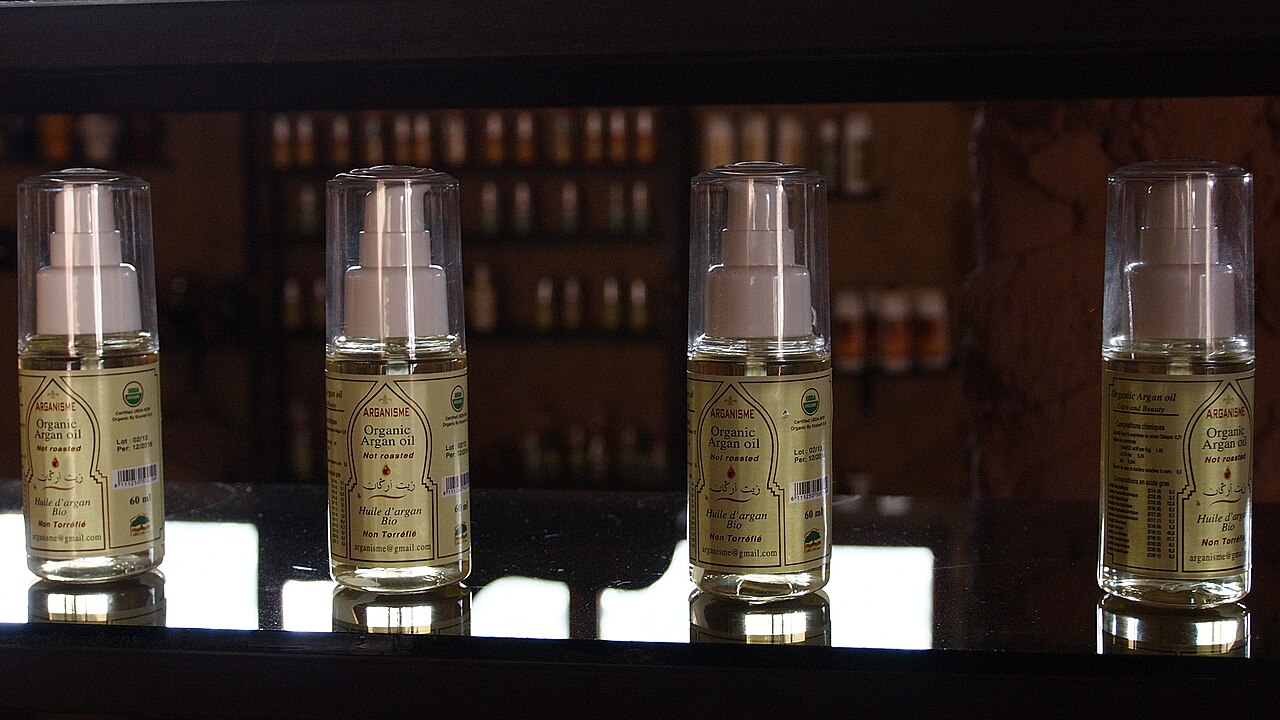
- Clear glass bottles — Argan oil degrades in light. It should be sold in dark or opaque bottles
- "Pure argan oil" sold at 50 MAD — It's either mixed with sunflower oil or it's entirely fake
Green Flags:
- Cooperative membership — Targanine, Amal, and other recognized women's cooperatives are trustworthy
- Dark packaging — Brown or blue glass bottles protect the oil
- Origin labeling — Should specify "Souss-Massa" or "Essaouira" region
- Cold-pressed — For cosmetic oil, look for "cold-pressed" (première pression à froid)
- Price: 150-500 MAD per 100ml for genuine product
Where to Visit Cooperatives
- Coopérative Marjana — Near Essaouira, with full production tours
- Coopérative Targanine — One of the first and most respected cooperatives
- ArganOil Cooperative (various locations near Marrakech) — Several along the Route d'Essaouira
- Amal Cooperative, Taroudant — Women-run with excellent tours and fair-trade practices
Quick Darija Phrases
- "Zit argan asli" — Pure argan oil
- "Bkama had?" — How much is this?
- "Hadi mn dima, walakin ghalia" — This is good, but expensive
- "Nuri bzaaf!" — It's very beautiful (useful for complimenting products)
The Verdict
Argan oil is Morocco's gift to the world — a product of extraordinary patience, women's labor, and one of the most resilient trees on the planet. Whether you're drizzling it over a fresh salad or smoothing it into your skin, every drop carries 1,000 years of Berber tradition.
Buy authentic. Support cooperatives. And try the amlou. Seriously, try the amlou.